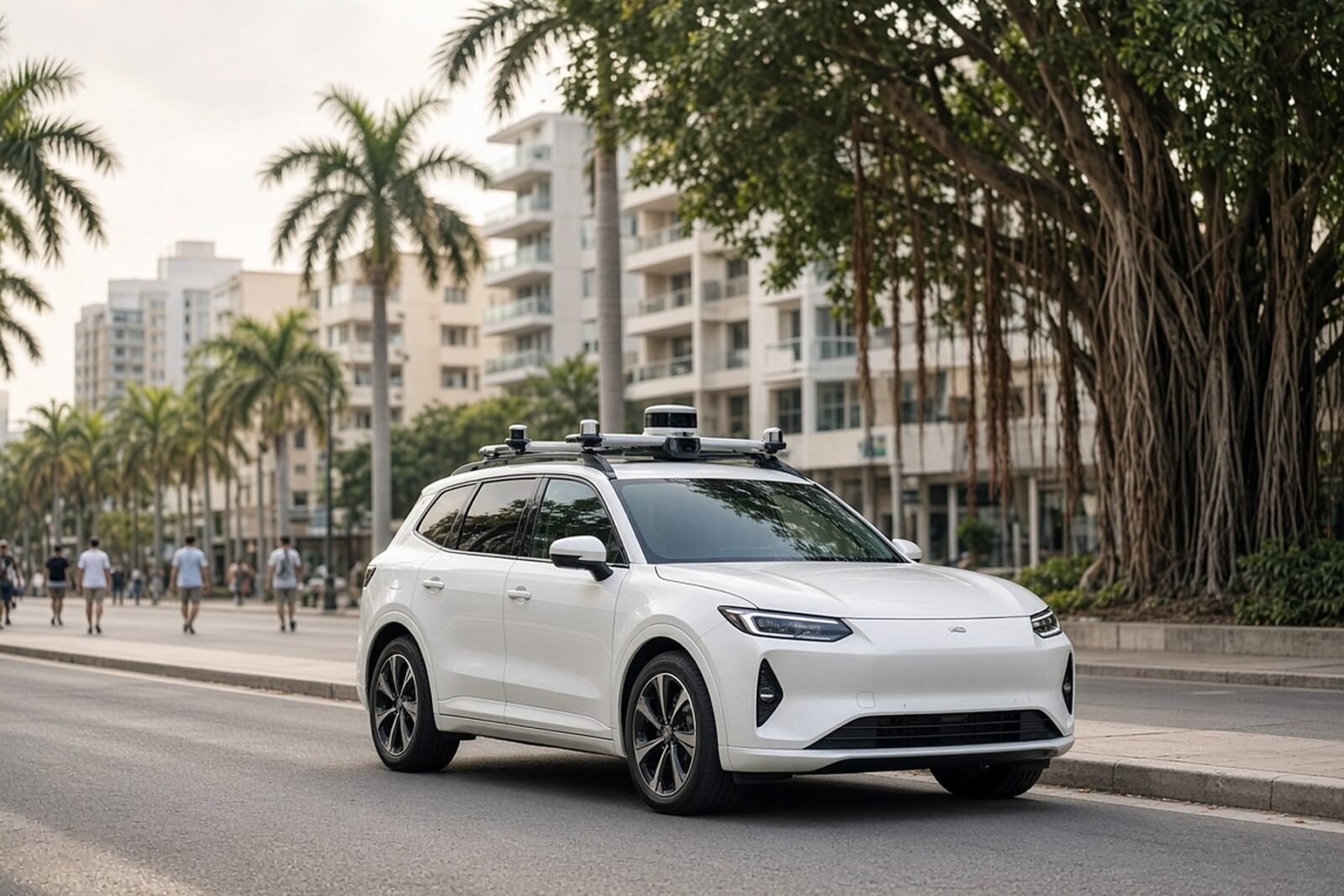
Pony.ai and Toyota said on 16 November that their jointly developed bZ4X robotaxi has joined Pony.ai’s fully driverless commercial fleet in Guangzhou. Riders can hail it 24 hours a day through the PonyPilot app or Pony.ai’s mini programs inside WeChat and Alipay. Fully driverless means no safety driver in the car.
What the announcement does not contain is just as useful. There is no count of cars in service, no timeline for the wider rollout and no safety or performance data for this model.
What is actually new
The bZ4X is one of three cars built on Pony.ai’s seventh generation (Gen-7) driving system. The other two come from BAIC and GAC. Pony.ai says the bZ4X was designed from the start for Level 4 driving, the tier where the car drives itself with no human fallback inside a defined service area.
According to the release, the two companies worked together on redundancy and fail-operational design, meaning the car can keep driving safely after a component fails instead of just stopping. The first mass-produced unit came off the line in February 2026.
The service area is narrower than “Guangzhou” suggests. CnEVPost reports that it initially covers the Nansha district and describes the start as pilot operations, while Pony.ai’s English release calls it commercial service.
What is still a plan
The headline figure, about 1,000 bZ4X robotaxis across major Chinese cities, is a target. The release says production is ramping and the car is being tested in other cities, with no dates. The same 1,000-car plan already appeared in Pony.ai’s interim report filed in Hong Kong in September, so it is not new information.
That filing gives the most recent hard fleet number: 1,975 robotaxis across all models as of 30 June 2026. Pony.ai said it was targeting more than 3,500 by the end of 2026. Pony.ai has not said how many of those are bZ4X cars.
The hardware, as Pony.ai describes it
When it unveiled the Gen-7 system in April 2025, Pony.ai said the driving kit was fully automotive grade and cost 70% less to build than the previous generation. It credited an 80% drop in compute cost and a 68% cut in solid-state lidar cost. Those are bill-of-materials claims from the company, without absolute dollar figures, so there is no way to check them from outside.
The sensor side is better specified. Lidar maker Hesai says every Gen-7 robotaxi carries four of its AT128 units, each rated for 200 meters of range, a 120 degree field of view and 1.53 million points per second. Those are datasheet ratings, not measurements on this car. The same Hesai release repeats a claim of a tenfold safety improvement over human drivers, with no method, baseline or data attached.
What we would want to see
For a driverless service, the useful numbers are boring ones: kilometers driven without a safety driver, remote assistance calls per thousand kilometers, and collisions against a human baseline in the same district. Pony.ai’s interim report mentions remote assistance and ground support teams, but gives no rates.
The “smoother acceleration, braking and cornering” the release promises is also unmeasured. No ride comfort metric was published.
What to do this week
Pony.ai reports third quarter results on 18 November. If you track robotaxis or evaluate autonomous driving suppliers, check that release for an updated fleet count and any split by Gen-7 model. Treat the 1,000-car figure as a plan until Pony.ai reports how many bZ4X units are carrying paying riders without a driver.
Sources
- Pony.ai: Pony.ai and Toyota launch fully driverless commercial services with Gen-7 bZ4X robotaxi (16 November 2026)
- Pony AI Inc. interim report for the six months ended 30 June 2026, HKEX filing
- Pony.ai: Pony.ai unveils seventh-generation robotaxi lineup (23 April 2025)
- Hesai: Four AT128 lidar sensors selected for all Pony.ai seventh-generation robotaxis (24 April 2025)
- CnEVPost: Pony AI and Toyota launch bZ4X robotaxi service in Guangzhou (16 November 2026)
- Pony.ai investor relations: press releases
Get the weekly email
The week's most useful AI news, a tutorial and an interview.

Lars Strother
Lars Strother is the senior editor for models and hardware at AI Observer, covering models and research, chips and hardware, and robotics. He came to journalism from engineering and still reads the benchmark tables before the press release. His coverage is measured and skeptical, and he wants to know what was tested, on what, and against which baseline.
Spotted a mistake? Tell us on the corrections page.