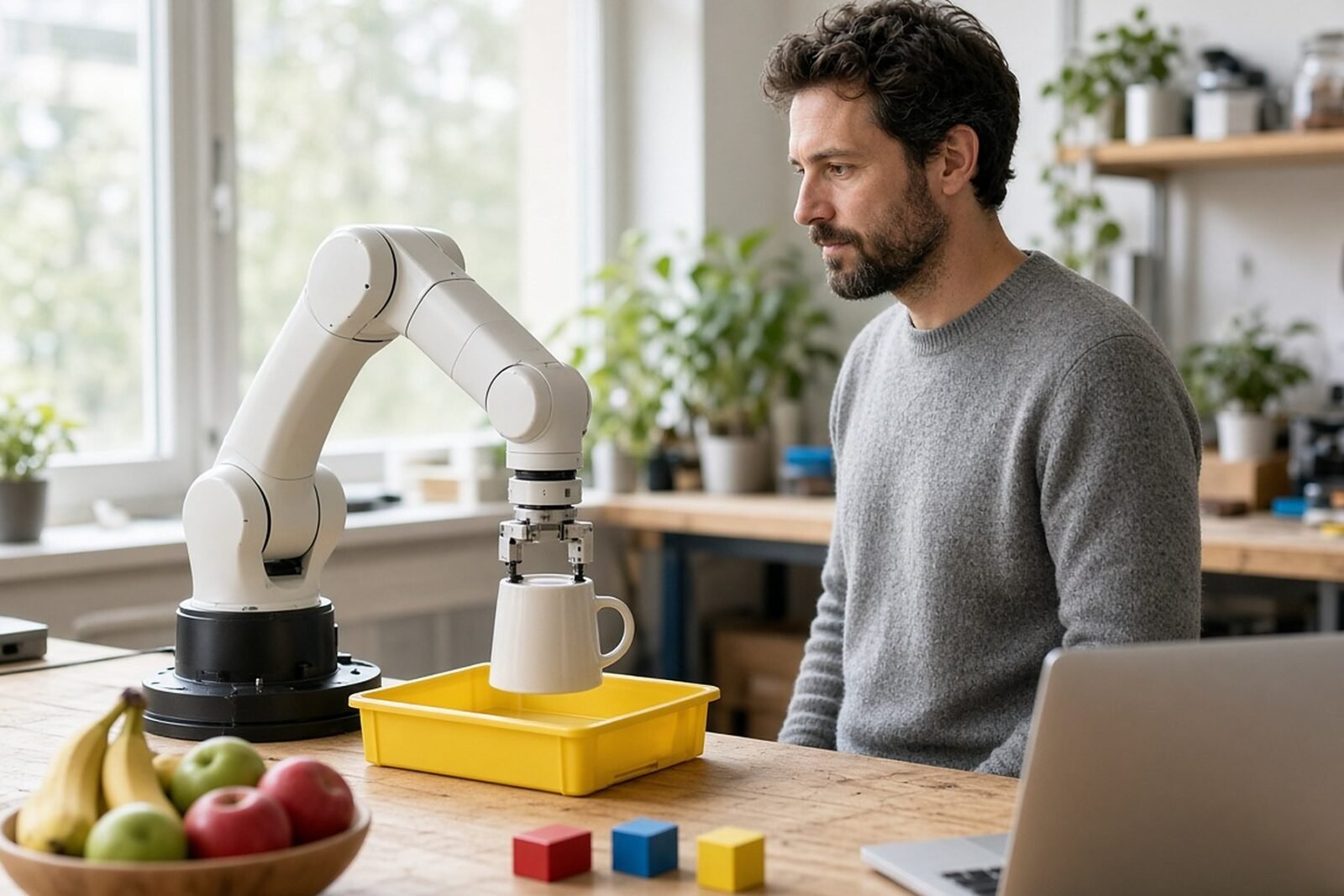
Runway released Praxis-1 as an open-weight robot model on 11 November, under the Apache 2.0 license, with inference and fine-tuning code. It is a 27B-parameter mixture-of-experts model, meaning only part of the network runs for each input. It predicts the next stretch of camera video and the robot’s next movements together, which Runway calls a world action model.
The headline number is 46.2% on NVIDIA’s RoboLab-120 simulation benchmark. The lead over the next world action model is inside the error bars, and the full-precision checkpoint needs a data center GPU.
What Runway released
Runway’s technical report lists three checkpoints: one for the single-arm DROID rig (a Franka arm with two cameras), one for two YAM arms, and a base model to fine-tune for a new robot. Each call returns 1.6 seconds of motion as 24 action rows at 15 Hz.
Runway says a call takes about 0.55 to 0.6 seconds round trip on one H100 server. Its GitHub repository adds that in RoboLab runs against a hosted server, the robot client saw a median of 1.1 to 1.4 seconds per call. Latency was also the bottleneck in NVIDIA’s recent VFlash work on robot planning.
What the benchmark shows
On NVIDIA’s RoboLab-120 leaderboard, Praxis-1 solved 555 of 1,200 simulated tabletop episodes. FLUX 3 Action from Black Forest Labs, the next world action model, scored 42.9%. The board lists a 5.7 point margin on both, so they overlap. We have explained why leaderboard rankings differ before.
Praxis-1 is fifth overall, behind two agentic language model systems, a model called Lakeside (51.0%) and BiMind v0.5 (49.2%). Runway says it is the top open-source robot foundation model on the board. The page we read does not make it easy to check which entries above it publish weights, so we could not confirm that. We also could not confirm whether NVIDIA re-ran the submission.
The split by difficulty is more telling. On complex tasks Praxis-1 solved 40.0%, against 28.2% for FLUX 3 Action. On simple tasks it trailed, 46.9% to 49.1%. Small samples, but the pattern favors Praxis-1 on multi-step tasks.
The hardware it needs
The DROID checkpoint’s model card lists 54.4 GB of bf16 weights and says inference needs one 80 GB GPU. The repository says one H100 is enough.
Runway’s launch post says the model runs on NVIDIA hardware including the RTX 5090 workstation card and Jetson Thor. The repository is more careful. Rounding the routed experts to 4-bit NVFP4 brings the weights to about 23.5 GB, so a 32 GB RTX 5090 “should fit”, but peak memory is not measured. NVFP4 has not been run in closed loop on that GPU family yet.
Quantized accuracy depends on the test. In the report, a 4-bit fine-tune solved 279 of 600 RoboLab episodes against 287 in bf16. On a harder suite in the repository, a 4-bit fine-tune of an earlier checkpoint solved 138 of 352 against 188, which Runway calls clearly lower.
Where it fails
Runway’s report lists three limits. The most common real-robot failure is reaching for an object that looks like the target. Vague instructions are harder than ones naming color or size, and chaining several steps from one prompt remains hard. NVIDIA’s GR00T 2, which also learns from human video, faces the same question of how far video pretraining carries.
What to do this week
If your team runs arm-based pick and place, start with the DROID checkpoint and the repository’s LoRA recipe, which fits on one 80 GB GPU. Run the repository’s simulated evaluation on the exact checkpoint and precision you plan to deploy, and measure latency on your own network. Treat 46.2% as a ranking on simulated tabletop tasks, not a success rate on your line.
Sources
Get the weekly email
The week's most useful AI news, a tutorial and an interview.

Lars Strother
Lars Strother is the senior editor for models and hardware at AI Observer, covering models and research, chips and hardware, and robotics. He came to journalism from engineering and still reads the benchmark tables before the press release. His coverage is measured and skeptical, and he wants to know what was tested, on what, and against which baseline.
Spotted a mistake? Tell us on the corrections page.