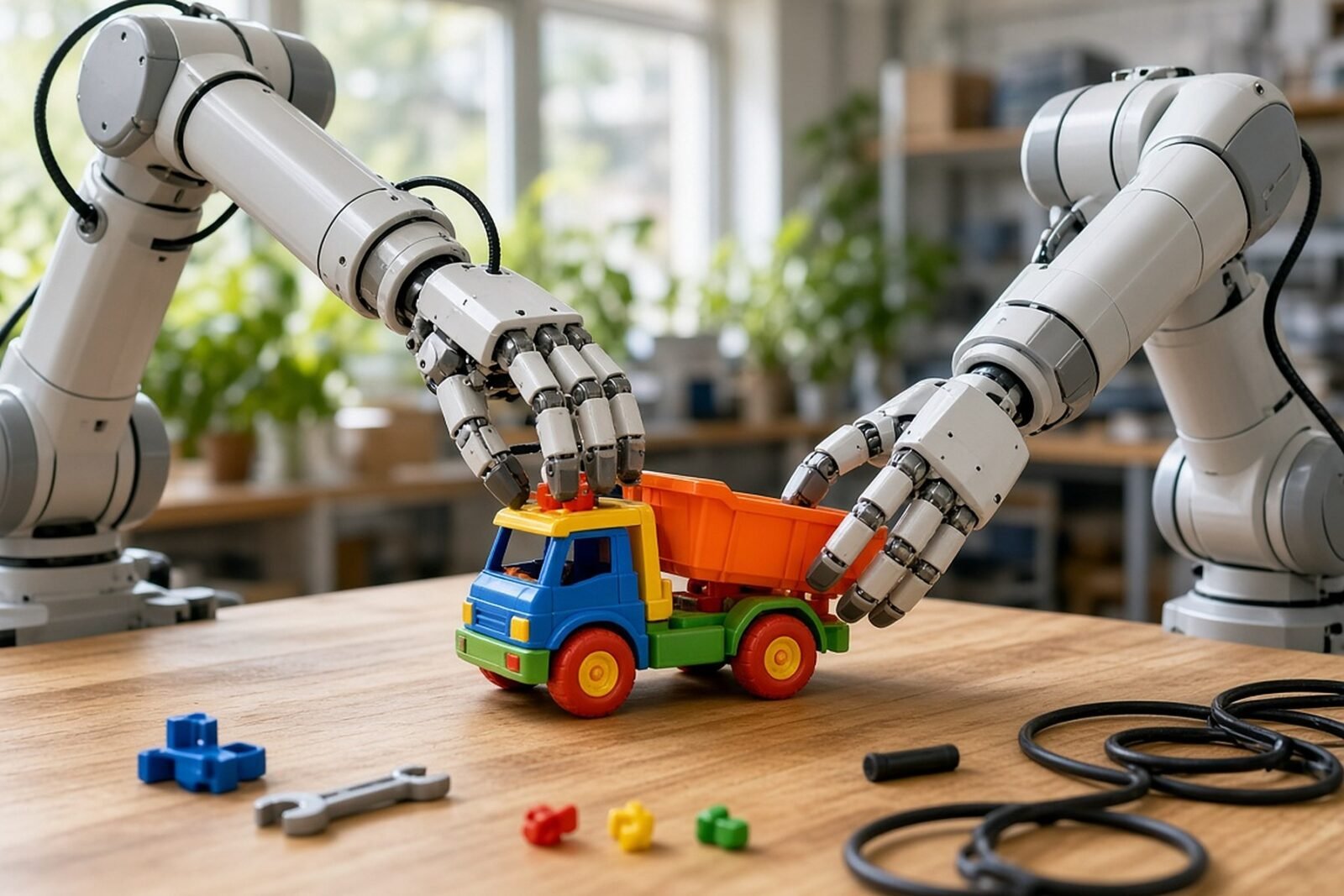
NVIDIA introduced GR00T 2, a robot foundation model that learns partly from video of people at work, at the Conference on Robot Learning in Austin on 9 November. Its headline number is 95% average success on 50 tasks after five demonstrations each. NVIDIA’s own GR00T 2 whitepaper explains why that figure needs care, and the research page says the code arrives in December.
What GR00T 2 is
NVIDIA calls it a world action model: one network that predicts the next few frames of camera video and the robot’s next actions together. A model that imagines how the scene should change can learn physics from human video, which contains no motor commands.
The whitepaper says it is a single 2B-parameter transformer built on NVIDIA’s Cosmos video model. It reads 0.8 seconds of low-resolution images from up to four cameras, plus joint state and a text instruction. Small per-robot heads turn the output into motor commands.
What it was trained on
The research page lists 402,730 hours of first-person human video, 10,184 hours of demos with a handheld UMI gripper, and 23,500 hours of robot teleoperation (a person steering the robot remotely). Only 275 of those robot hours come from the Unitree G1 humanoid.
NVIDIA put 100,000 hours of the human video on Hugging Face as Human-1M-100K, under a CC BY 4.0 license that allows commercial use with attribution. We looked at handheld-gripper data before, when AIRoA-0 trained on handheld demos alone.
The 95% figure and how the tasks were picked
NVIDIA tested 50 tasks that a two-handed robot had never seen in its own data. Zero-shot, GR00T 2 succeeded in 40% of trials. One demo per task lifted that to 71%, and five demos, under three minutes of robot data, to 95%.
Each step was a LoRA fine-tune (training small add-on weights instead of the whole model) of about 30 minutes on one RTX 5090. The whitepaper’s caveat matters more: “The 50 tasks were chosen among those the model learns with five episodes (at least 80% success), so the five-episode rate is high partly by construction.”
So the 95% shows how fast the model converges on tasks it can learn. It says little about how many tasks it can learn at all.
On longer jobs the reported margins are large: 71.7% on six multi-stage arm tasks against at most 12.5% for the baselines, per the whitepaper. Every run was NVIDIA’s own, on its own lab setups, and we found no independent replication.
The humanoid version
GR00T 2 Turbo is a lighter variant that runs on the G1 itself. NVIDIA says each prediction takes 124 ms on the robot’s Jetson Thor module, and a separate controller executes the plan at 50 Hz. Only the high-level reasoning model runs off the robot.
That is a similar latency problem NVIDIA tackled with VFlash on Jetson Thor last week. Reported G1 results: popcorn served in all 48 trials, and a table cleared in 93% of 30 trials.
What is open, and what is not yet
NVIDIA’s CoRL announcement calls GR00T 2 open and claims top three placings on four robot leaderboards. Our guide to what leaderboards measure explains why rankings on different boards can disagree.
Neither the blog nor the research page states a license for the weights. Humanoids Daily reports that NVIDIA’s Jim Fan said weights for both variants come in December. Nexuni, Foxconn and Siemens are testing or evaluating the model, NVIDIA says, but none has announced production use.
What to do this week
If your team runs robot pilots, download a slice of Human-1M-100K and check whether the footage looks like your work. Hold GR00T 2 plans until the December code and license appear. When a vendor quotes the 95%, ask for success rates and trial counts on your own tasks.
Sources
Get the weekly email
The week's most useful AI news, a tutorial and an interview.

Lars Strother
Lars Strother is the senior editor for models and hardware at AI Observer, covering models and research, chips and hardware, and robotics. He came to journalism from engineering and still reads the benchmark tables before the press release. His coverage is measured and skeptical, and he wants to know what was tested, on what, and against which baseline.
Spotted a mistake? Tell us on the corrections page.