Press W and the scene moves forward. Tap the left arrow and the camera pans. There is no game engine: a video model paints every frame as you play. In Apple’s FastFrames demo, the world now reacts in about 50 milliseconds instead of most of a second.
FastFrames comes from Apple and Cornell University researchers, described in a preprint posted to arXiv on 17 November (a paper not yet peer reviewed). It is a set of speedups and two models for interactive video generation, meaning video that keeps reacting to your inputs while it is being made.
What the demo shows
The project page plays two versions side by side, fed the same input at the same moment: a model’s official code on the left, Apple’s optimized version on the right. One pair is LingBot, a world model you walk through with the keyboard. The other is RealWonder, a Stanford and USC model that turns a photo into a scene you can drag around with simulated physics.
Apple’s LingBot demo guide says you start from an example or your own photo, then use WASD to move and the left and right arrows to pan.
According to the paper, the 1.3 billion parameter LingBot drops from 842 ms per response with its fastest official setup to 52 ms on eight GPUs, a 16 times speedup. RealWonder drops from 1,141 ms to 51 ms, about 22 times faster. In the clips the originals lag noticeably and the optimized versions keep up. These are Apple’s own measurements; we have not tested them.
How Apple made it fast
The team timed every step of a current model and found that two plumbing stages ate over half the time. One is the VAE decoder, which turns the model’s compressed sketch of a frame into pixels. The other is the KV cache update, where the model refreshes its memory of earlier frames. Apple swapped both for small, purpose-built networks.
The two new models build on Alibaba’s open Wan 2.1. Per the paper, FastFrames-S (1.3 billion parameters) makes a 480p frame in 36 ms on one Nvidia B200, and FastFrames-L (14 billion) takes 45 ms on a server with eight B200s. Apple claims the small one matches the quality of a model nearly 8 times slower. The paper cites studies where people start to notice delay at roughly 50 to 60 ms.
The authors also make a sharp point about frames per second. A model that renders a 30 frame clip in one second scores 30 FPS, yet you still wait a full second to see your keypress land.
What it is not
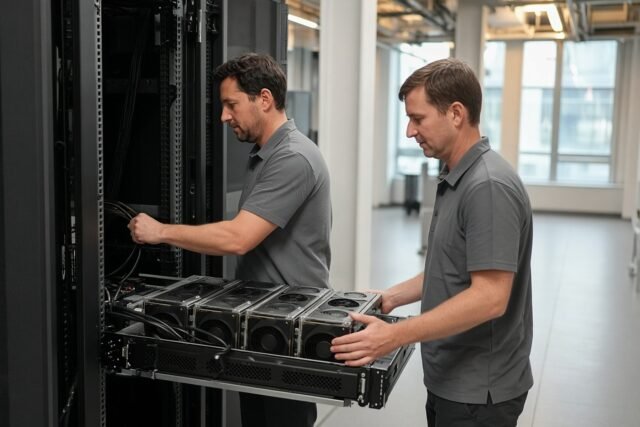
This is not an Apple product, and Apple has announced nothing for the iPhone or Mac. The figures come from B200 data center GPUs, and the model card asks for Linux and an Nvidia card. Our explainer on NPUs and GPUs covers why this work stays in the server room for now.
The licenses are research only. The FastFrames-L weights come under Apple’s machine learning research license, which rules out commercial use. The LingBot-World v2 code and weights keep their CC BY-NC-SA 4.0 license, also non-commercial.
The consumer version of the same idea already exists, as we covered in our look at Genie 4 for AI Ultra users. Live generation is spreading to faces too, as with Kyutai’s talking face for voice assistants. What FastFrames adds is a map of where the lag hides.
What to do this week
Watch the side by side clips on the FastFrames project page and count how long each version takes to react. If your team has B200 or H100 access (the paper says H100s run about 25 to 50% slower), the GitHub repo has setup steps for the LingBot demo. Read the license before you build anything you plan to sell.
Sources
- FastFrames: Video Generation at Interactive Latency, Apple project page
- FastFrames preprint on arXiv (2611.23226), Chou et al., 17 November 2026
- FastFrames-S model card, Hugging Face
- FastFrames-L model card and license, Hugging Face
- FastFrames LingBot demo guide, GitHub
- RealWonder project page, Stanford University and University of Southern California
Get the weekly email
The week's most useful AI news, a tutorial and an interview.

Lars Strother
Lars Strother is the senior editor for models and hardware at AI Observer, covering models and research, chips and hardware, and robotics. He came to journalism from engineering and still reads the benchmark tables before the press release. His coverage is measured and skeptical, and he wants to know what was tested, on what, and against which baseline.
Spotted a mistake? Tell us on the corrections page.