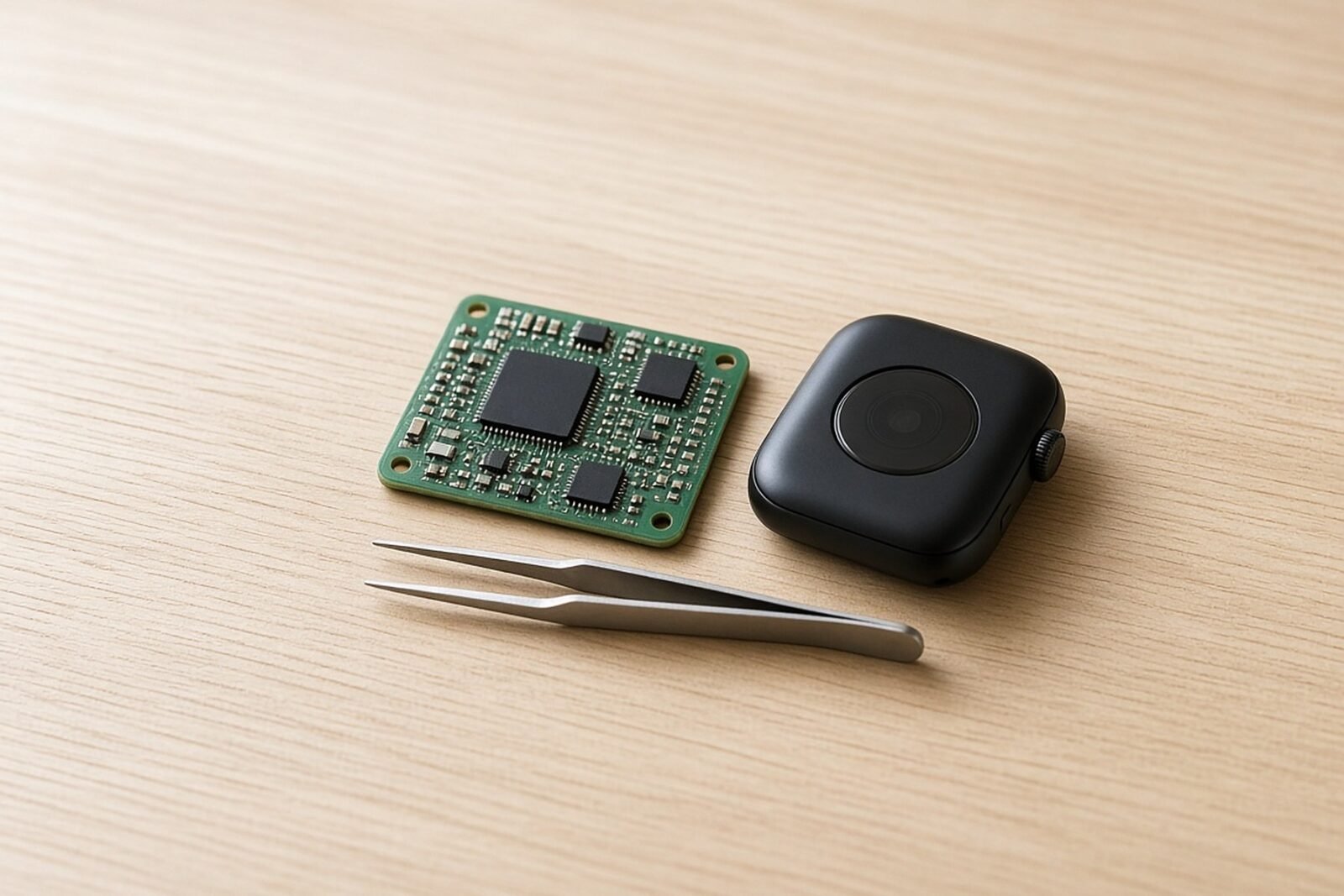
Winbond says its new CUBE-Lite memory moves up to 8GB/s for about 70mW, aimed at small edge AI chips in image processors, wearables and microcontroller boards. The Taiwanese memory maker announced it on 4 November. Every CUBE-Lite figure so far comes from Winbond, and the part is still in validation.
The pitch is narrow. Edge AI chips need more memory bandwidth than a microcontroller usually gets, on milliwatt power budgets, and Winbond wants to supply it without a standard mobile memory interface.
What Winbond has published
The release lists up to 8GB/s at approximately 70mW, energy of about 1pJ per bit (picojoules for each bit moved) and access latency of about 20ns. CUBE-Lite is semi-custom, meaning Winbond adapts it to each customer’s chip. Target uses are AI-ISP (image signal processors with AI blocks), wearables, microcontroller designs and embedded vision systems running Micro Linux.
The numbers hang together. 8GB/s is 64 gigabits per second, and 70mW spread over that gives about 1.1pJ per bit, as Electronics Brief worked out. That is the memory’s own transfer energy at peak rate. The processor doing the inference draws power on top of it.
Winbond has not said what capacity CUBE-Lite comes in, what it costs or which chipmakers are designing it in. Mass production is targeted for the first half of 2027.
The baseline is LPDDR4X, and the claims differ
Winbond compares CUBE-Lite with LPDDR4X, the low-power DRAM standard JEDEC published in 2017. One x16 LPDDR4X channel running at 4,266Mb/s per pin reaches up to 8.5GB/s, according to a Micron LPDDR4X datasheet. So the headline bandwidth roughly matches one standard channel. The argument is about power and integration cost, not speed.
The release claims the simpler interface cuts SoC (system-on-chip) controller power by more than 10 times against an LPDDR4x implementation, citing “Winbond engineering data”. It does not say which controller, process node or workload produced that figure, and we could not confirm it independently.
Winbond’s own CUBE product brief from February words it differently. It says CUBE-Lite delivers 8 to 16GB/s, “equivalent to LPDDR4x x16/x32”, at “only 30% of LPDDR4x power consumption”. The brief does not define what that 30% covers either. The two figures may measure different things, so they should not be read as one saving.
Where the saving would come from
It is not a lower I/O voltage. JEDEC’s LPDDR4X standard cut the I/O supply (VDDQ) from 1.1V to 0.6V. CUBE-Lite’s VDDQ runs from 0.9V down to 0.75V, above that 0.6V.
Winbond credits the interface instead. The brief says no LPDDR PHY (the physical interface block on the SoC) is needed and that CUBE-Lite works with 28nm and 40nm processes. It also claims a smaller SoC die and lower LPDDR4 IP licensing cost. Those are plausible gains for a mature-node edge chip, but Winbond has not published a shipping design that shows them.
Our explainer on what NPUs and GPUs each do covers the accelerators this memory would feed, and our guide to small language models on a laptop covers how much memory local models need.
What is still missing
Trade coverage, including New Electronics, repeats Winbond’s figures without new measurements, and we found no third-party power or latency results. Winbond also gives no idle or standby power, which matters for a wearable that spends much of its time doing nothing.
What to do this week
If you are specifying an edge AI chip for 2027, ask Winbond for the test conditions behind the 10x and 30% claims, the capacity options and the packaging your SoC would need. Then compare the full memory power budget, idle included, against a single LPDDR4X x16 channel.
Sources
- Winbond: Winbond introduces CUBE-Lite for edge AI applications (4 November 2026)
- Winbond: CUBE product brief (February 2026, PDF)
- JEDEC: updates to LPDDR4 and LPDDR4X standards (8 March 2017)
- Micron: automotive LPDDR4/LPDDR4X SDRAM datasheet (PDF)
- Electronics Brief: Winbond targets 8 GB/s at around 70 mW (6 November 2026)
- New Electronics: Winbond unveils CUBE-Lite memory platform (6 November 2026)
Get the weekly email
The week's most useful AI news, a tutorial and an interview.

Lars Strother
Lars Strother is the senior editor for models and hardware at AI Observer, covering models and research, chips and hardware, and robotics. He came to journalism from engineering and still reads the benchmark tables before the press release. His coverage is measured and skeptical, and he wants to know what was tested, on what, and against which baseline.
Spotted a mistake? Tell us on the corrections page.