AMD said on 3 November that its data center revenue nearly doubled to a record $8.5 billion in the third quarter. It was the first quarter in which AMD shipped its MI455X GPUs and complete Helios racks for revenue. What it did not say is how much of that money came from AI chips rather than server processors.
What AMD reported
Total revenue for the quarter to 26 September was $13.4 billion, up 45% from a year earlier, according to AMD’s results release. The data center segment brought in $8,546 million, against $4,341 million a year earlier, and its operating income rose to $2.9 billion.
AMD expects fourth quarter revenue of about $17 billion, plus or minus 3%. On the earnings call, chief financial officer Jean Hu said data center revenue should grow about 50% from the third quarter.
The number AMD left out
The data center segment mixes EPYC server CPUs, Instinct GPUs, network cards and FPGAs (reprogrammable chips). The slides filed with the SEC give one figure for all of it. So the 97% growth tells you demand is strong, but not how fast the AI accelerator business itself is growing.
Chief executive Lisa Su offered only direction: server CPU revenue should roughly double in 2027 and data center AI revenue should “significantly more than double”. She asked listeners to treat these as “markers”. Hu added that AI revenue will pass server CPU revenue in dollars for the first time in the fourth quarter.
Helios is shipping, and the performance claims are AMD’s own
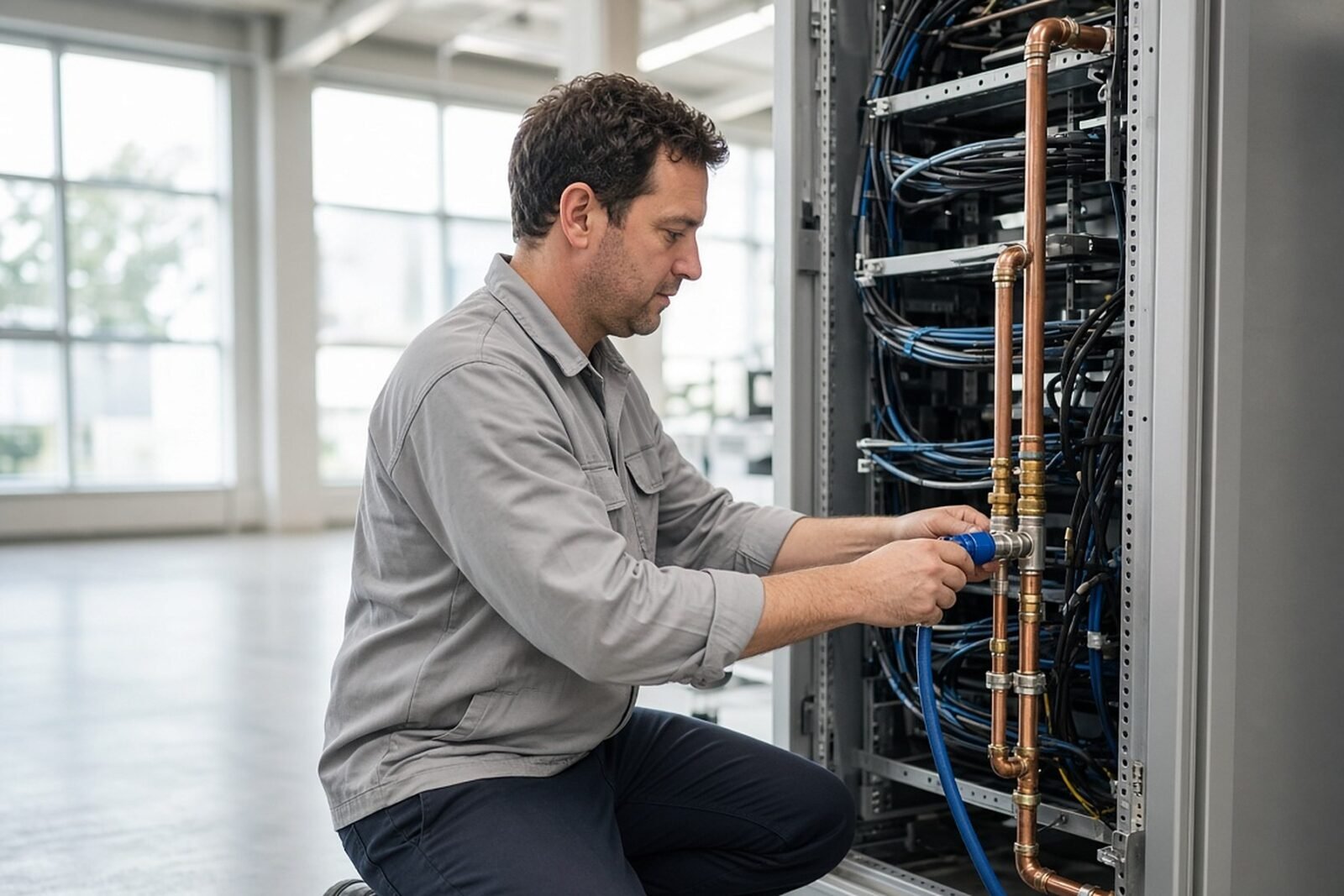
Helios is a rack-scale system: one liquid-cooled rack that combines 72 MI455X GPUs, EPYC “Venice” CPUs and networking. AMD’s Helios page calls it a reference design for partners to build and sell, and Su said HPE, Dell, Lenovo and Supermicro start shipping systems this quarter. Su said Anthropic, Meta, Microsoft, OpenAI and Oracle already run workloads on their first racks.
Su also said the MI455X “leads in compute FLOPS, memory capacity, and scale-out bandwidth”. AMD released no benchmark results with the earnings to support that, and the only baseline Su named was “the competition”. Its own product page is not consistent either: it lists per-GPU memory bandwidth as 23.3 TB/s in the spec table and 19.6 TB/s in the compute tray section. We could not confirm which figure applies to shipping parts.
Agents are lifting CPU sales too
Su credited AI agents, software that plans and carries out multi-step tasks, for part of the server CPU growth. Agents run code and call tools between model calls, and that work lands on ordinary processors. Cloud and enterprise server sales both more than doubled from a year earlier, CRN reported from the call.
What the growth costs
Inventory rose about $3 billion in the quarter to $11.5 billion, and free cash flow fell to $554 million from $1.53 billion a year earlier. GAAP earnings (the standard accounting measure) also carry a $1.1 billion non-cash charge for warrants AMD issued to customers under an earlier agreement. Su said demand is higher than supply and that memory and other component prices are rising.
Export rules also decide who can buy these chips, and AMD lists them among its business risks. Some Chinese labs train on domestic accelerators instead, as Meituan says it did for its LongCat-2.5 model trained on Chinese chips.
What to do this week
If you rent GPU capacity, ask your cloud provider when MI455X instances will be available and ask for results on a workload like yours, not peak FLOPS. If you follow AMD’s numbers, the fourth quarter report is the first test of the claim that AI revenue has passed CPU revenue. AMD’s next investor appearances are the UBS conference on 1 December and Barclays on 9 December.
Sources
Get the weekly email
The week's most useful AI news, a tutorial and an interview.

Lars Strother
Lars Strother is the senior editor for models and hardware at AI Observer, covering models and research, chips and hardware, and robotics. He came to journalism from engineering and still reads the benchmark tables before the press release. His coverage is measured and skeptical, and he wants to know what was tested, on what, and against which baseline.
Spotted a mistake? Tell us on the corrections page.